 |
||
|
The Feel-Good Guide to Sports, Travel, Shopping & Entertainment
|
||
| Main | Sports Events | Holidays & Observances | Pop Culture | Shopping | Travel |
|
Main
Iceland sits on a unique base. Unlike most countries that are firmly settled on one of the continental plates, this island nation spans the Eurasian and North American land masses. Where the continental plates drift apart the earth's crust is thin enough to turn underground water into steam. Fire and Ice The best place to see this natural wonder in action is in the Haukadalur valley at the Geysir Hot Springs Geothermal Area in Iceland. The Golden Circle bus tour from Reykjavick drives through the landscape which is dotted with steaming openings in the earth. Our guide explains that Iceland has learned to harness this steam power to provide nonpolluting heat and energy to homes. No reliance on fossil fuels in Iceland. Clean and easy to obtain geothermal heat powers the country. As we get to the Geysir Hot Springs Geothermal Area a sulfuric smell, mildly resembling rotten eggs, fills the air. It turns out that the smell of sulfur is generated by the minerals that the water brings to the surface as it is heated, The bubbles explode in bursts of sulfuric steam.
Walking into the area where the geysers can be seen the group is warned to stay on the roped paths. The steaming pools of water are hot enough to burn anyone who accidentally steps in one of them! A few of the group test the water with the tip of a finger and confirm that the water is really hot. The rest of the group decides to just stay on the paths and trust the guide... Besides the steaming puddles there are several deeper holes with signs in front of them. The ultimate goal is to see Geysir and Strokker, the two biggest of the geysers here. While Geysir no longer is active, Strokker still spouts every 5 to 15 minutes to the delight of crowds of tourists. Litli Geysir There are about thirty much smaller geysers and hot pools in the area. The first named pool on the path is Litli Geysir ('Little Geysir'). The thick, boiling fluids with the sulfurous smell looks like an abandoned witches' cauldron. It doesn't spout like its bigger namesake, but just keeps a constant bubble. Like many of the other pools, the little geyser does not have the buildup of steam that creates the spectacular eruptions in the active geysers naturally tied into earthquake activity in the area. Strokker, the Churn
In between eruptions, the Strokker is not very impressive. The water is very still except for an occasional movement as it rises and falls. With each upward movement, the tension increases...will this be the eruption? After
several moments of expectant waiting, attention wanders to the
people walking in the area and the steaming pools of liquid. The
sulfur smell contributes an eerie feeling to the scene...and the
geyser suddenly erupts! The area also hosts the Geysir Museum. Visitors are welcomed to a multimedia exhibition that explains what makes the geysers pop and how the island of Iceland was created from the activity of volcanoes.
Photos & Animation of Strokker and the Haukadalur area - More than 40 photos of the geysers in action include an animation of Stokker erupting. There is also a selection of photos of the area surrounding the geyser pools. Geysir Wikipedia - A good overall piece on the Geysir Hot Springs Area of Iceland with history, pictures and links to many other resources.
|

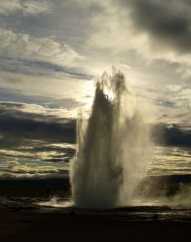 Despite the
name, the country of Iceland is one of the hottest spots on the
planet. The volcanic activity that formed the island continues
to feed hot thermal springs and spray gushing steam from geysers.
Despite the
name, the country of Iceland is one of the hottest spots on the
planet. The volcanic activity that formed the island continues
to feed hot thermal springs and spray gushing steam from geysers.
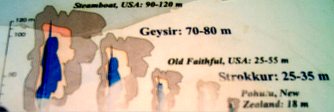
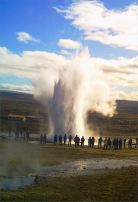 This one is still very active. It may be smaller than the 70
to 80 meter high plume of steam that Great Geysir produces, but
the 25 to 35 meters high eruption of steam is an amazing sight.
The eruptions are about on the same level as Old Faithful geyser
in
This one is still very active. It may be smaller than the 70
to 80 meter high plume of steam that Great Geysir produces, but
the 25 to 35 meters high eruption of steam is an amazing sight.
The eruptions are about on the same level as Old Faithful geyser
in