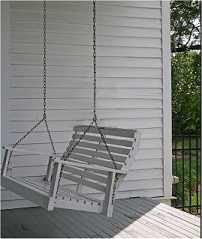
There is a magical quality to porch swings. In his summertime classic Dandelion Wine, Ray Bradbury describes the "ritual of the front-porch swing."
"In the garage they found, dusted, and carried forth the howdah, as it were, for the quiet summer-night festivals, the swing chair which Grandpa chained to the porch-ceiling eyelets…they sat, smiling at each other, nodding, as they swung silently back and forth, back and forth."
Perhaps it is the soothing rhythm or the reassuring creak of the porch swing that attracts us, or the companionable silence or quiet conversation. Or maybe swings simply remind us of more genteel times.
Materials and construction
"Perhaps it is the soothing rhythm or the reassuring creak of the porch
swing that attracts us, or the companionable silence or quiet conversation..."
Although porch swings can be purchased in a wide range of materials, the most common are wicker and wood. You can also make your own porch swing from one of the myriad of woodworking patterns available at garden centers, hardware stores, or on the Internet. You can even improvise with a rope chair or a wicker chair with the legs cut off and a support base added.
Whether you are buying or making a porch swing, here are things to look for:
• Seat depths vary from 18 to 36 inches (50-100 cm). There is no one "correct" depth -- it's a matter of personal comfort.
• Chair slats should have some curve or slant to them to make a more comfortable seat, and there should be enough space between slats to allow air to circulate.
• Swings can hold one to three people depending on the length of the seat. Of course, the bigger the swing, the heavier the load and the sturdier the supports need to be.
• Swings with additional length-wise supports under the chair slats will be sturdier and will swing more evenly.
• All joints should be bolted or screwed together, not nailed.
Pine, maple or oak swings will not
weather as well as cedar or teak, but
can be painted with an exterior paint
to extend their life.
• Pine, maple or oak swings will not weather as well as cedar or teak, but can be painted with an exterior paint to extend their life. They also suit a sheltered porch area.
• Wooden bench backs come in a variety of styles. Back slats can run horizontally, vertically with a topper or even vertically at differing heights to form a "round" back. Some styles will suit certain homes better than others.
• Seat cushions, covered in durable outdoor fabrics, can adapt a swing to just about any architectural or decorating style, and also make the swing more comfortable for whiling away those summer evenings.
Installation
• Allow a 4 foot (1.2 m) arc for the swing to move freely.
• Use galvanized or stainless steel chain or marine-grade braided nylon or polyester rope, and eye-bolts or S-hooks with 4-6 inch (10 cm-15) shafts. Using S-hooks allows easier removal of the swing for winter storage but is not as secure as using eye-bolts.
• ALWAYS hang the swing from a roof joist, not the roofing material itself. If the joists on your porch roof are not exposed, cut away a section of roofing to find them. Otherwise, don't hang the swing from the ceiling -- use a frame instead.
• Drill a pilot hole slightly smaller than the shaft of the eye-ring or S-ring. This will ensure a snug fit to the shaft of the ring. Tighten the ring securely, using pliers or a screw-driver for the last turn.
• Measure the required chain. As an example, seven foot (2.1 m) chains hung from a beam 8 feet (2.4 m) above the floor will lift a swing about 18 inches (45 cm) off the ground. If you have a measurement, your hardware dealer can cut the exact length of chain you need and you won't have to cut it with a hacksaw.
• Use four chains to hang your swing -- two chains from each hook, one to the front of the swing and one to the back. It's easier to hang swings with holes in the arms, but swings with chains attached to the seat or to the bottom supports give a more comfortable ride without as much twisting and wearing of the chains or the ropes.
• Check your swing each spring and replace any rusted chain or bolts. Also maintain the finish of the wood because weathered wood eventually will loosen fasteners and produce splinters.
No porch?
Don't despair if you don't have a covered porch.
• Some swings come suspended in their own frames or can be installed on decks on a wooden A-frame.
• Put one in your garden, hanging from an arbor. Train vines up the sides and soon you'll have a leafy hide-away nook.
• Hang a board with rope from a sturdy, level tree branch
• If you need something that takes up less space, consider a glider -- a bench that gently moves forward and back on a mechanized base. There are even kits available that will turn a wooden garden bench into a glider.
So don't just sit there this summer -- swing away and make some memories!
About the Author Debbie Rodgers, Nova Scotia, Canada
http://www.paradiseporch.com
Debbie Rodgers, the haven maven, owns and operates Paradise Porch, and is dedicated to helping people create outdoor living spaces that nurture and enrich them.


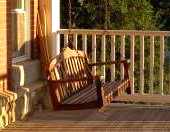 There is a magical quality to porch swings. In his summertime classic Dandelion Wine, Ray Bradbury describes the "ritual of the front-porch swing."