|
The Feel-Good Guide to Sports, Travel, Holidays & Entertainment
|

| Main | Sports Events | Holidays & Observances | Pop Culture | Travel |
|
Main
The Belmont Stakes Triple Crown Winners | Belmont Stakes Trivia
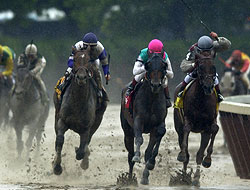
The third leg of the racing world's famed Triple Crown is the Belmont - run in Belmont Park in Elmont, NY. The race course is 1 1/2-mile, 12 furlongs, and is a sand track. The field of three year old champions compete for a place in history and there is no handicap... the best horse will win. The Kentucky Derby in Churchill Downs and the Preakness in Pimlico, Maryland are steeped in strong southern tradition, but the Belmont is a true New York affair where formality is not an issue. There are no fashions except for the hats that the fans wear. The Belmont may not be the most tradition bound of the races, but it is the oldest. The first running of the Belmont Stakes in 1867 took place six years before the Preakness and a full eight years before the first Kentucky Derby was run. In fact, the Belmont is the oldest, continuously run, race in North America. On June 19, 1867 at Jerome Park race course in the Bronx, NY, a filly named Ruthless won the purse of $1800. The current Belmont track, the largest race track in the United States, opened in 1905. Although most racing fans might not be aware of the history and traditions of the Belmont, they do exist... and they include much more than the traffic getting there and the long lines for refreshments.
Until 1997, the official theme song of the race was "Sidewalks of New York". The following year, officials decided that the song made famous by Frank Sinatra, "New York, New York," would be more familiar to a larger audience. Today, as the post parade begins it is the strains of Sinatra that set the stage for the oldest race in the Triple Crown set. The tradition of the post parade began at the 1890 Belmont Stakes. Before that, horses were taken directly from the paddock area to the starting post before the race. Another long standing tradition has been lost to the changes of modern life. Every year after the Belmont was run, a local pub near the track, Esposito's Tavern, painted its picket fence to match the winner's colors. When the local tavern became a church, the tradition was abandoned. Locals don't expect it to be revived anytime soon! During the 1997 face lift, the Belmont acquired a new tradition. In the area where the horses are saddled, the stand-ease area, track officials added a set of cast iron horses about 4 feet high with iron jockeys. After the race is run, the jockey is painted with the colors of the winning horse. When the horse who wins the Belmont is a Triple Crown winner, the cast iron horse is moved to a permanent position in the triple crown ring. There are Belmont traditions that have lasted through the years. None match the age of the giant white pine in the paddock, which is is 300 years old. This tree is the basis for the Belmont track logo. The Winners Photo Gallery, on the 2nd floor of the Belmont clubhouse in the Belmont Room, boasts the photo finishes of past Belmont victors dating back to 1912. The night before every Belmont, the previous year's winner is honored at a trainer's banquet. The Belmont Charity Ball held at Meadowbrook Country Club is the climax of pre-Belmont celebrations. A new tradition, the Belmont Festival at Garden City, started in 2004. The traditional blanket of between 300 and 400 white carnations that drapes the champion in the winners circle takes 10 man hours to put together. The flowers are shipped in from either California or Bogota, Colombia. The name, "The Run for the Carnations," comes from this tradition. The Kentucky Derby is the "Run for the Roses," the Preakness is the "Race for the Black Eyed Susans." The Belmont Stakes is also known as "the Test of Champions" - pass it and you win the Triple Crown...
1919-
Sir Barton Sir Barton's victories in the 1919 Kentucky Derby, Preakness and Belmont Stakes started the Triple Crown tradition, but it wasn't until 1930 that the name Triple Crown was used. Charles Hatton, writing for the Daily Racing Form, coined the phrase in writing about Gallant Fox's victories in the three races.
More about the Belmont around the Web:
|


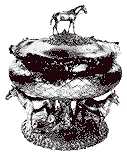 The traditional
trophy, the Belmont silver bowl is presented in the winner's circle
as the blanket of carnations is placed on the horse. The Tiffany-made,
covered, silver bowl donated by the Belmont family stands 18 inches
high, 15 inches across, and 14 inches at the base. The bowl celebrates
the heritage and history of the race. The cover shows a silver
figure of Fenian, who won the third Belmont Sweepstakes in 1869.
The bowl is supported by three horses. These represent Matchen,
1748, Herod, 1758 and Eclipse, 1764. In order to be considered
a
The traditional
trophy, the Belmont silver bowl is presented in the winner's circle
as the blanket of carnations is placed on the horse. The Tiffany-made,
covered, silver bowl donated by the Belmont family stands 18 inches
high, 15 inches across, and 14 inches at the base. The bowl celebrates
the heritage and history of the race. The cover shows a silver
figure of Fenian, who won the third Belmont Sweepstakes in 1869.
The bowl is supported by three horses. These represent Matchen,
1748, Herod, 1758 and Eclipse, 1764. In order to be considered
a


