 |
||
|
The Feel-Good Guide to Sports, Travel, Shopping & Entertainment
|
||
| Main | Sports Events | Holidays & Observances | Pop Culture | Shopping | Travel |
|
MAIN A Step-By-Step Guide to Picking the Perfect Diamond
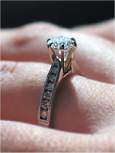
Proposing is tough enough, but finding the perfect ring, set with the perfect diamond is even tougher. The search for your engagement ring may seem impossible, but with these step-by-step instructions from Whiteflash.com, an online diamond and jewelry boutique. you'll find the ring you imagined for the special moment... Educate yourself - the 4 C's Start the education process by learning about the four Cs of diamond quality. "Understand how diamonds are evaluated and categorized," says Brian Gavin, an internationally known diamond expert and co-founder of Whiteflash.com. The four Cs refer to clarity, cut, color and carat, and by understanding each, Gavin says, you can determine which is most important to you and then start shopping. "This will also help you determine how much you're willing to spend," he adds. Get input from the bride-to-be Find out what she wants. Gavin says, "It's better to be safe than sorry." Take her to a jewelry store - that is, if marriage has been a topic of conversation and a surprise engagement is not on your agenda. "Have her try on as many rings as possible," suggests Gavin. "Make her look at every shape of diamond and type of setting." Another way to gauge whether she prefers pear-shaped over princess cut is have her look at bridal magazines like "The Knot" or "Brides" or at an online diamond expert's site like Whiteflash.com. "Either way, you'll know exactly what will make her swoon when you pop the question," says Gavin. "We also refer to carat in points," says Gavin. "There are 100 points in a carat and as points or carats increase, so does the price of the diamond." For example, the price per carat will be less for a .90 diamond than the price per carat for a 1.00 diamond even if the color and clarity are the same. "Determining the size of the diamond, and then the cut and color is really going to help establish your budget parameters," he says. The cut - make and sparkle Diamond dealers also refer to cut as "make" - as it is the only feature of a diamond that can be controlled by man, and it must be precise. Each facet - or small plane surface on the diamond - must be cut to align perfectly with the facet opposite it. "There's not much room for error," says Gavin, "because this affects the diamond's ability to sparkle, or what we call in the industry—brilliance." How important is clarity and what are inclusions? Gemologists use a grading scale set forth by the Gemological Institute of America (GIA) to determine a diamond's clarity - how clean the gem appears when viewed through a magnifier. Most diamonds contain some "inclusions" - crystalline fractures or irregular crystal growth. The Gemological Institute of America GIA Clarity Grading Scale ranges from Internally Flawless (IF) through
included (I3). Flawless (F) and Internally Flawless (IF) being the highest, with the next best grade being VVS1 and 2 or very slight inclusions followed by VS1 and 2, referring to very slight inclusions, which according to Hoskins, "are difficult to see even with magnification." "The clarity of the stone you purchase will depend on your level of comfort and budget," he says. His advice: Inclusions are more difficult to see in ideal cut and super ideal cut diamonds, because of the exactness in the cut. Establish a budget and stick to it After determining the four Cs, you should be able to set a budget or at least have a figure in mind. The general rule of thumb is to set aside two months worth of salary. "If you're hesitant to set a dollar amount, look at your options in diamonds and settings to get a general idea of what you'd like to spend," advises Gavin. You have more options than the local jeweler around the corner. There are independently owned boutiques, national chains and, now with the Internet revolution, online diamond boutiques like Whiteflash.com. No matter whom you buy from, make sure the jeweler is reputable and affiliated with the American Gem Society (AGS). "If you're unsure of the jeweler's credibility, check with the local Better Business Bureau," suggests Gavin. "You can also test how knowledgeable the staff is about diamonds, look into customer reviews and look over the company's return and repair policies … this is important."
Time to shop! Grades and fingerprints Another option is to ask for a fingerprint of the diamond. This is a three-dimensional drawing of the diamond indicating the four Cs, along with the stone's overall dimensions and enhancements. Inclusions and blemishes should be noted. "As soon as you receive the diamond, double-check all of the information, including the bill of sale and drawing to make sure that it is, in fact, the diamond you purchased," finishes Gavin. Set the diamond Both Gavin and Hoskins suggest allowing four to six weeks before popping the question if you go the handcrafted route. If you're simply lost in the decision making process -- propose with diamond in-hand and pick out the setting later -- together! About the Author... For more information about A Cut Above (ACA) diamonds from Whiteflash.com, visit the company's online store at www.whiteflash.com or contact them directly at (877) 612-6770. Courtesy of ARA Content Also see -> Choosing Pearl Jewelry - Buying Advice Diamond Engagement Ring Buying Guide More about buying an engagement ring around the Web: Blue Nile Engagement Ring Guide |

 You've searched for the perfect partner, the perfect setting and the perfect words to