|
The Feel-Good Guide to Sports, Travel, Holidays & Entertainment
|

| Main | Sports Events | Holidays & Observances | Pop Culture | Travel |
|
Main
In North America, the first day of summer is marked by the summer solstice, which occurs this year on Thursday, June 20, 2025 at exactly 9:41 PM EDT. Welcome to summer 2025
Sol + stice derives from a combination of Latin words meaning "sun" + "to stand still." As the days lengthen, the sun rises higher and higher until it seems to stand still in the sky, a pivotal moment in the seasonal calendar. As a major celestial event, the Summer Solstice results in the longest day and the shortest night of the year. Because the Earth revolves around the sun tilted slightly, things heat up differently on the planet north to south. While the Northern hemisphere celebrates in June, people in Australia, South America, and other populations in the Southern hemisphere celebrate their longest day of the summer in December. also see in Summer -> 2025 Summer concert schedules | 2025 Milwaukee Summerfest
Awed by the great power of the sun, civilizations have for centuries celebrated the first day of summer otherwise known as the Summer Solstice, Midsummer (see Shakespeare), St. John's Day, or the Wiccan Litha. The Celts & Slavs celebrated the first day of summer with dancing & bonfires to help increase the sun's energy. The Chinese marked the day by honoring Li, the Chinese Goddess of Light.
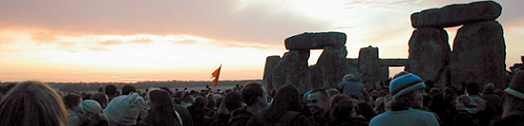
Today, the observance is celebrated around the world, most notably in the UK at Stonehenge, where thousands gather to welcome the sunrise on the Summer solstice. Throughout Europe, other pagan spirit gatherings or festivals are still common in June, when groups assemble to light a sacred fire, and stay up all night to welcome the dawn. In Paris, the day is marked with free concerts during an annul music festival. In the U.S., the city of Santa Barbara in California holds the nation's most talked-about Summer solstic celebration -- featuring a parade, performance artists, and other entertainment during a festival that lasts a full three days. On the East Coast, New York City traditionally ushers in the solstice with a music concert at the Cathedral of St. John the Divine. A bit more risqué celebration happens in Brooklyn at the annual Coney Island Mermaid Parade.
• Pagans called the Midsummer moon the "Honey
Moon" for the mead made from fermented honey that was part of wedding ceremonies performed
at the Summer solstice. • Ancient Pagans celebrated Midsummer with
bonfires when couples would leap through the flames for good luck (in the belief that the higher the jump, the higher your summer crops would grow. • Midsummer
was thought to be a time of magic, when evil spirits were said
to appear. To thwart them, Pagans often wore protective garlands
of herbs and flowers. One of the most powerful of them was a
plant called 'chase-devil', known today as St.
John's Wort used by modern herbalists as a natural mood
stabilizer.
On the Web,
discover more about the topic, where and how Summer solstice
is celebrated around the world along with related history, folklore
and rituals that mark the much-awaited long, bright days of summer
.... Summer Solstice - Good overview of its history, customs & holidays, illustrations, date & time charts and related resources, from Wikipedia. BBC Religion - Summer Solstice - A brief overview of Pagan rituals and ceremonies with related resoures for more facts & information.
|