 |
||
|
The Feel-Good Guide to Sports, Travel, Shopping & Entertainment
|
||
| Main | Sports Events | Holidays & Observances | Pop Culture | Shopping | Travel |
|
MAIN What you do not want done to yourself, do not do unto others. Confucius
Its orgins can be traced back to the Chinese philosopher Kong Zi, or Master K'ung, best known in the Western world by the Latin form of his name, Confucius. Born the youngest of 11 children during the Zhou Dynasty about 551 BC, Confucius grew up under humble circumstances, but was bright and well-educated enough to assume a local government position while still in his teens. He next spent his early adult life in teaching, but later returned to government as a sort of freelance political advisor to local governments. He promoted negotiation over warfare, and always advised respect, love and benevolence as the most enlightened way to takes one's place within the family, and within society as a whole ("Do not impose on others what you yourself do not desire.”) While he lived, Confucius was only a minor influence, but upon his death in 479 BC his writings were promoted by followers Mencius and Hsun Tzu. Eventually the texts attracted attention throughout China and eventually came to be regarded as sacred. Subsequently, Confucius was deified and for centuries afterward animal sacrifices were made at his tomb in official ceremonies contrary to his teaching ("Respect the spirits - but keep them at a distance.") The cult of Confucius was later abandoned in the 16th century when images depicting him were replaced with tablets inscribed with his teachings. The cult's revival in the early 20th century was short lived when the People's Republic of China came to power. Today, millions of Chinese still adhere to his philosophy and will identify themselves as followers of Confucianism. Elsewhere around the Web, learn more about the man and his philosophy with chronicles of his life & teachings, comparative studies, related artwork & images ...
Confucianism - Excellent overview and introduction with a discussion of its early history & development, notable controversies, a brief biography of its founder, selected quotes, related pictures & links to more information, from Wikipedia. Confucian Documents - The complete library online including the Confucian Canon, Five Classics, I Ching, and related texts. Confucius & Socrates: The Teaching of Wisdom - Comparative study between the two philosophers with discussions on their lives & deeds, teachings, attitudes and influence. Confucius - Biography, philosophy, his emphasis on education & study, with related bibliography & links to more information, from the Stanford Encyclopedia of Philosophy. Confucianism Beliefs & Confucius - China Travel Guide featuring information on the life of the philosopher, his teachings & influence plus links to more information on notable travel destinations within China, including the Temple of Confucius in Beijing & his burial site in Kong Lin. Confucius.org - The full lexicon of "Confucius said" with 499 select quotes from the master including related picture archive. |

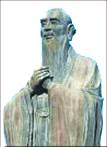 Originating as more of a moral guide to "gentlemanly" conduct than an established religion, Confucianism has been a major cultural influence in China for centuries.