|
The Feel-Good Guide to Sports, Travel, Shopping & Entertainment
|

| Main | Sports Events | Holidays & Observances | Pop Culture | Shopping | Travel |
|
MAIN
In the landmark decision, Justice Anthony Kennedy eloquenlty wrote for the majority of the court when he stated that the hope of same sex couples "is not to be condemned to live in loneliness, excluded from one of civilization's oldest institutions. They ask for equal dignity in the eyes of the law. The Constitution grants them that right." The 5-4 decision rested in part on the court’s interpretation of the 14th Amendment which guarantees all Americans equal protection under the law.
With the passage of a same sex marriage law in New York, (the largest US state to do so), an important watershed moment in America's social history was marked in 2011 which practically doubled the number of people in the US who could legally marry someone of the same sex, The passage of the New York same sex marriage law followed Massachusetts, Iowa, the District of Columbia, Vermont, and New Hampshire in adopting similar legislation that caused contention among voters in each state in which it is passed. In 2012, the US gay marriage question made worldwide headlines after finding an advocate in US President Barack Obama, which brought the decades-long debate over same-sex marriage in America to the national level. As the Defense of Marriage Act (DOMA) was deemed unconstitutional in May of 2012 (by a US Federal Appeals court) legalization of gay marriage from coast to coast appeared to be on the horizon. In June 2013, the US Supreme Court struck down a provision in the contentious Defense of Marriage Act to allow same sex couples the same benefits as heterosexual couples. The court invalidated a provision of the federal Defence of Marriage Act that had prevented married gay couples from receiving a range of tax, health and retirement benefits that are generally available to married people. The vote was 5-4
1989 marked the first time that a national government granted rights similar to heterosexual couples when Denmark extended property and inheritance rights for gays and lesbians under what was known as "registered partnerships." Norway, Sweden, Iceland and several other EU nations followed suit shortly after, with their own official recognition of same-sex marriages or similar arrangements (such as domestic partnerships, civil partnerships or civil unions.) By 2001, The Netherlands was the first country to legalize gay marriage by giving same-sex couples the right to marry, divorce and adopt children. This led the way to at least a dozen more countries granting same-sex couples full rights to marry under the law, most notably in Canada, Spain, Belgium, Norway and South Africa. More recently, the United States joined Ireland in making gay marriage the law of the land in 2015. Meanwhile, fierce opposition to gay marriage continues in many other countries as social conservatives express concern over parenting issues, traditional religious teachings, and the preservation of the idea that marriage should be exclusively reserved as a union between a man and a woman.
also see -> Gay Pride | | NYC Gay Pride Parade
| ||||

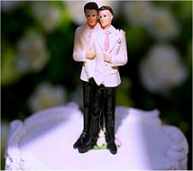 Dateline June 26, 2015 -- Settling one of the major US civil rights battles of the modern era,