| MAIN
Travel
Tourist
Attractions Iceland Golden Circle Tour
Walking
Between Two Continents
Unlike
Iceland whale watching or tours that are limited to warmer seasons (or Iceland northern lights tours that require the long dark nights of winter) most companies run the Golden Circle tour throughout
the entire year. The
tour usually consists of stops at the Kerið crater, the Gullfoss waterfall,
the Geysir hot springs and Þingvellir national park. All of these are famous
attractions that should be included in a trip to Iceland. They are all close to
Reykjavik and can easily be enjoyed in one day, making for the ideal day tour.
We
travelled with Reykjavik
Excursions. The agent who booked the tours for us, Hildur Armannsdottir, was
extremely friendly and helpful. In addition to advising us to take the Golden
Circle Tour, she arranged for a tour that took us, and our luggage, to the Blue
Lagoon spa for an few hours of relaxation before dropping us at the airport for
our flight back home. Hildur explained a little about the Icelandic language and
the family atmosphere that often surprises visitors to Iceland. The
population of Iceland is small and most of the current residents are descendants
of the original settlers. The language that is spoken has remained true to the
ancient roots to such an extent that most grade school children can read the ancient
Sagas in the original language and understand them perfectly. Hildur
pointed out that Icelandic culture has been formed by both the closeness of the
community and the struggles to tame an unforgiving land. The waterfalls in Iceland
are regarded with a special fondness that visitors may not understand. They are
not just a source of beauty or national pride. Icelanders feel a true kinship
with their land and the falls are regarded as real friends. We
began with a stop at one of the greenhouses that provide fresh vegetables for
Icelanders. In this land of arctic weather and short growing seasons, thermal
heat and glass help deliver garden products for a good part of the year. It
seems that every stop includes an entry or exit through a souvenier shop and this
was no exception. Handmade sweaters and Icelandic crafts based are easy to find.
After a quick snack we were off to see the major attractions.
Kerid
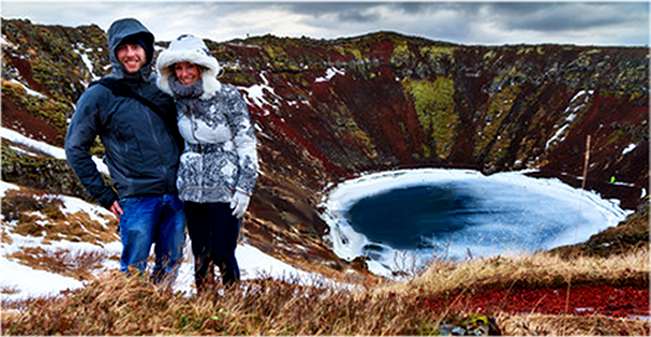
Crater - The first tourist attraction on the tour is Kerið, the mouth
of an extinct volcanic. The water-filled crater is 55m deep and some 3000 years
old. The water is an odd greenish color during the warmer months and a reflective
sheet of ice during the winter. Like the Grand Canyon in the USA, the majesty
of the view is difficult to capture in pictures.
The rocky slopes rise at a steep
angle from the crater resulting in an eerie panorama that should be on your itinerary
if you plan a visit to Iceland. Kerið is a natural amphitheatre with excellent
acoustics. Iceland's famous Bjork decided it was the ideal location for an outdoor
concert. The performers floated on the water while entertaining crowds gathered
on the sides and above the basin.
Gullfass
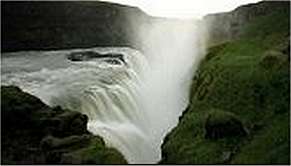
- The name Gullfoss or Gullfass translates to the Golden Waterfall.
Visitors who watch the sun play on the water as it cascades 32m down in two stages
fully understand the meaning of the name. The massive falls are located on the
Hvitá river. Under the right conditions, colorful rainbows dance on the
spraying water filling the air above the canyon. In
winter, ice formations form uncanny sculptures. The cascading water and spray
are captured by the cold and frozen into amazing shapes. Small wonder that the
people of Iceland express such a love for their waterfalls. The beauty of this
place is a sight that will not soon be forgotten. Geysir
Hot Springs Geothermal Area - The geothermal field in Haukadalur is a
natural wonder of hot springs and boiling mud pools. The Great Geyser
even gave its name to this spectacular phenomenon. Today, the Geysir itself is
no longer erupting, but nearby Strokkur sends up a column of water and steam up
to 30 meters high every few minutes to the delight of onlookers, who strive to
catch the moment on film. At
the Geysir center visitors can enjoy a multimedia exhibition and learn more about
the geology and history of the area. Also on spot is a restaurant and accommodation
for those wishing to stay overnight. In summertime, the highland route of Lyngdalsheiði
provides a convenient shortcut to Þíngvellir for those traveling
on four wheel drive. Pingvellir
National Park - A UNESCO World Heritage site, Þingvellir national
park is of immense historic and symbolic importance to Icelanders. It was long
the site of the original Alþing, or national parliament of the settlers,
and the setting for many of the most important events in the history of the island.
Established in 930, the Alþing was an assembly of free men that gathered
at Þingvellir for two weeks each summer to settle disputes, set laws and
arrange marriages. Imagine the significance of gathering again with friends and
distant family members between long, dark, isolated Icelandic winters and it is
easy to understand why modern Icelanders are so friendly to visitors. Þingvellir
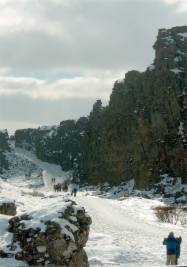
is also renown for its geological significance. The area is located on the Mid-Atlantic
ridge, where the continents of Europe and America drift apart, causing earthquakes
and volcanic activity. Standing in the Almannagjá fissure, the visitor
is literally situated between the continental plates. Þíngvellir
is also known for its exquisite beauty. The birch-covered lava fields and the
clear blue waters of Lake Þingvallavatn produce a harmonious, almost serene
landscape. In summer, why not end the day with a midnight riding tour at Þingvellir
national park? Skįlholt
Church - One of the extra stops on our tour was to visit this historical
site. The new church is set in beautiful surrounding and the stained glass windows
provide a riot of color in the simplicity of the interior. This important site
in early Icelandic history might have become the capital if nature had not intervened... During
the bus ride, as we travelled through the countryside, we were treated to an Icelander's
perspective of Iceland. Our guide asked us to call her Dottir since her name was
impossible to get right for our un-Icelandic tongues. She spoke both English and
German fluently. We
were serenaded with traditional Icelandic ballads and children's songs; given
a background on all of the sights; instructed in the history of Iceland and introduced
to the hidden mythical world so vital in Iceland. We
were delivered back to the door of our hotel after a day of touring. We still
had enough energy left to taxi back to the city to have an authentic Icelandic
dinner at Laekjarbrekka
restaurant. |